


Now manufacturing enterprises are turning to intelligent manufacturing, and the introduction of industrial robots is the choice of most people. Typical applications of industrial robots include welding, painting, assembly, collection and placement (e.g. packaging, palletizing and SMT), product inspection and testing; All work is completed with efficiency, durability, speed and accuracy. Industrial robotics technology is changing rapidly and making amazing advances over the years, from typical pick-and-place to high-precision collaborative robots.
Articulated robots are robots that have a jointed, two-link layout similar to our human arms. Articulated robots can be classified according to how many points of rotation they have, with some devices having up to seven degrees of freedom. The mechanical complexity of these units makes them relatively expensive and slightly slower than other types.
Articulated robots remain by far the largest type of robot, according to InteractAnalysis. Articulated robots accounted for 59.6 percent of global shipments in 2019 and are expected to account for 57.5 percent of the total market by 2023.
The advantage of articulated robots is that they can circumvent obstacles that would block other types of robots. These devices are perhaps the most common type in use today. They can be used for: take-and-place, dispensing, packing, parts and welding, etc.
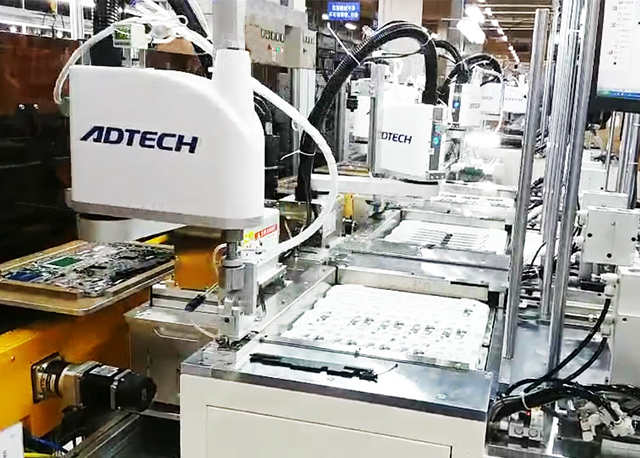
SCARA robots, horizontal multi-joint robotic arm robots, they can move along the x and y axes, but the arms are rigid in the direction of the Z axis and locked in place along the z axis. As a result, the SCARA robot has selective compliance, which has advantages in some assembly operations, such as inserting a round pin into a round hole.
collaborative robot (cobot for short) is a robot designed to have close interaction with humans in a co-working space. Until 2010, most industrial robots were designed to operate autonomously or with limited guidance, so they don't have to worry about close interaction with humans, and their actions don't have to worry about the safety of people around them, all of which are features that collaborative robots need to take into account.
Separate units: Humans and robots work nearby, but in separate physical workspaces. No human-computer interaction or synchronization.
Sequential collaboration is the most advanced level commonly adopted in today's factories and needs to be implemented through machine vision and artificial intelligence. In addition, tangential branches of collaborative robots are robots used in surgical applications, such as the first robotic eye surgery performed in 2016. Perhaps the most famous of these is Intuitive Surgical's daVinci robotic surgical system, which, while seemingly fitting, was not defined as a cobotic by its developers. The robot's every move is controlled by the surgeon, but with a precision that no human hand can come close to.
Clearly, this level of precision and fine motor control can be found in countless applications in industrial environments. However, high-precision collaborative robots are currently too expensive for ordinary manufacturing plants to afford for the time being.